

I use to believe in magic.
Not black magic.
Not Disney.
Not the amazing magical world of Harry Potter.
No, I used to believe in the magic of abortion.
Growing up in a Christian home, I always believed abortion was wrong. I understood it ended a life, but how exactly it happened I had no clue. I don’t know if it was ignorance, lack of personal history, or just the fact that NOBODY I knew (inside or outside the church) talked about abortion. For whatever reasons, I saw abortion in magic-like terms. As if it was some peaceful procedure consisting of unhooking a life-support machine from the baby, kindly letting it die in its sleep. Or, maybe more realistically, abortion was a merciful execution; a gunshot to the head type procedure instantly killing the unborn baby with no pain. Certainly, abortion wasn’t an overtly violent or torture-like process. However, my magical ignorance turned to shock and painful awareness when I actually did some research on abortion procedures. Their is nothing peaceful about them. In fact, they are quite the opposite. The process of aborting a developing baby is violent, abhorrent and barbaric. When you can grasp the facts of the procedures along with the facts of the developing baby, how can you see it any other way?
Before we jump into the types of abortion procedures, let’s take a look at what abortion is and how developed the unborn child is during these procedures. Abortion ends a pregnancy by destroying and removing the developing child. That baby’s heart has already begun to beat by the time the mother misses her period and begins to wonder if she might be pregnant (about 31 days after the mother’s last menstrual period or LMP). Surgical abortions are usually not performed before seven weeks, or 49 days LMP. By that time, the baby has identifiable arms and legs (day 45) and displays measurable brain waves (about 40 days). During the seventh through the tenth weeks, when the majority of abortions are performed, fingers and genitals appear and the child’s face is recognizably human. In addition, the scientific evidence converges upon the conclusion that unborn humans can feel pain from 20 weeks after fertilization with a significant and growing body of evidence suggesting as early as 11 weeks post-conception. In fact, some scientists contend, although it has not been proven, that the unborn baby may be able to experience pain as early as 7 weeks post-conception. In case you’re wondering, 66.7% of abortions are done at 7 weeks or later equalling approximately 707,000 a year in the U.S.
Just a reminder, most abortions are elective and performed on perfectly healthy babies. The vast majority of all abortions performed today are done for social, not medical reasons — because a woman doesn’t feel ready for a baby at the time, because her partner wants her to have an abortion, etc. Approximately 93% of all induced abortions are done for elective, non-medical reasons such as these.
DISCLAIMER: The following descriptions of abortion procedures are graphic and will most likely be disturbing to you. I understand if you want to skim over parts or simply stop reading right now. I felt that way when I first started researching. It was SO hard to bring myself to read and view pictures of abortion procedures (you never get numb to it). Many times, I could only read a little bit and then take a break, so if you feel that way I understand. But PLEASE, don’t let the fear and pain of the truth keep you from pursuing it.
RU 486 (first trimester, chemical abortion, used within 4-7 weeks LMP)
The RU 486 procedure requires at least three trips to the abortion facility. In the first visit, the woman is given a physical exam, and if she has no obvious contra-indications (“red flags” such as smoking, asthma, high blood pressure, obesity, etc., that could make the drug deadly to her), she swallows the RU 486 pills. RU 486 blocks the action of progesterone, the natural hormone vital to maintaining the rich nutrient lining of the uterus. The developing baby starves as the nutrient lining disintegrates.
At a second visit 36 to 48 hours later, the woman is given a dose of artificial prostaglandins, usually misoprostol, which initiates uterine contractions and usually causes the embryonic baby to be expelled from the uterus. Most women abort during the 4-hour waiting period at the clinic, but about 30% abort later at home, work, etc., as many as 5 days later. A third visit about 2 weeks later determines whether the abortion has occurred or a surgical abortion is necessary to complete the procedure (5 to 10% of all cases). RU 486 is documented to be unsafe, even deadly, for women. Chemical abortions account for 22.6% of all abortions.
Suction Aspiration/Suction Curettage (first trimester, surgical abortion, used within 13 weeks LMP)
Suction aspiration is the abortion technique used in most first trimester abortions. A powerful suction tube (29 times more powerful than a household vacuum cleaner) with a sharp cutting edge is inserted into the womb through the dilated cervix. The suction dismembers the body of the developing baby and tears the placenta from the wall of the uterus, sucking blood, amniotic fluid, placental tissue, and fetal parts into a collection bottle.
A suction curettage type of abortion involves a curette, a hook-shaped knife. The curette scrapes out the uterus for any more parts, and a suction machine goes through the uterus once again to make sure all parts have been removed.
Just as a reminder, the baby isn’t given anesthesia or killed prior to the procedure.
Dilation and Evacuation or D&E (second trimester, surgical abortion, used within 13-24 weeks LMP)
The developing baby literally doubles in size between the 11th and 12th weeks of pregnancy. Soft cartilage hardens into bone at 16 weeks, making the child too large and strong to pass through a suction tube. Therefore, forceps with sharp metal jaws are used to grasp parts of the developing baby, which are then twisted and torn away. This continues until the child’s entire body is removed from the womb. Because the baby’s skull has often hardened to bone by this time, the skull must sometimes be compressed or crushed to facilitate removal. If not carefully removed, sharp edges of the bones may cause cervical laceration. Bleeding from the procedure may be profuse.
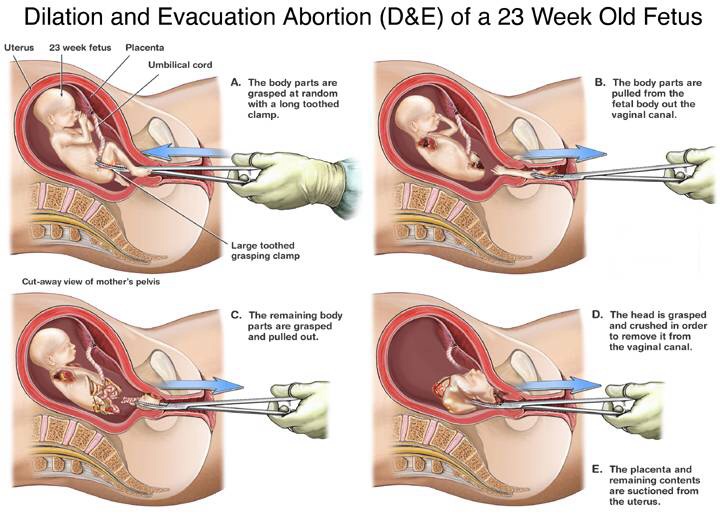
Former abortionist, Dr. Anthony Levatino, performed over 1,200 abortions. In May of 2013, he testified before members of a Congressional committee about his experiences performing abortions. Here is a quote from his testimony about the D&E procedure:
“The toughest part of a D&E abortion is extracting the baby’s head. The head of a baby that age is about the size of a large plum and is now free floating inside the uterine cavity. You can be pretty sure you have hold of it if the Sopher clamp is spread about as far as your fingers will allow. You will know you have it right when you crush down on the clamp and see white gelatinous material coming through the cervix. That was the baby’s brains. You can then extract the skull pieces. Many times a little face will come out and stare back at you.”
Again, the baby isn’t dead or given anesthesia prior to the procedure.
Salt Poisoning or Saline Abortion (second and third trimester, chemical abortion, used after 16 weeks LMP)
This technique is used after 16 weeks of pregnancy, when enough fluid has accumulated in the amniotic fluid sac surrounding the baby. A long needle is inserted through the mother’s abdomen and 50-250 ml (as much as a cup) of amniotic fluid is withdrawn and replaced with a solution of concentrated salt. As the baby’s lungs absorb the salt solution, it begins to suffocate. It may struggle and may even have convulsions. The saline also burns off the baby’s outer layer of skin. Saline abortion can take one to six hours before the baby is no longer viable. The mother goes into labor about 33 to 35 hours after instillation and delivers a dead, burned, and shriveled baby. About 97% of mothers deliver their dead babies within 72 hours. Because the procedure is often quite long, many times the woman is left to labor alone.
Once more, the baby isn’t dead or given pain-reliever and, more than likely, can feel pain.
Dilation and Extraction (D&X) or Partial Birth Abortion (second and third trimester, surgical abortion, used after 20 weeks LMP)
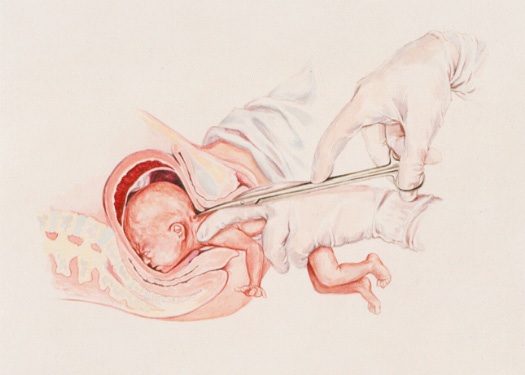
Although this procedure is illegal as of 2003, it was used to abort thousands of unborn babies prior to being banned. Guided by ultrasound, the abortionist reaches into the uterus, grabs the unborn baby’s leg with forceps, and pulls the baby into the birth canal, except for the head, which is deliberately kept just inside the womb. (At this point in a partial-birth abortion, the baby is alive.) Then the abortionist jams scissors into the back of the baby’s skull and spreads the tips of the scissors apart to enlarge the wound. After removing the scissors, a suction catheter is inserted into the skull and the baby’s brains are sucked out. The collapsed head is then removed from the uterus.
In a testimony before a judiciary committee, Brenda Pratt Schafer, a registered nurse with 14 years of experience at the time of her testimony, spoke about her experience witnessing a partial birth abortion. Her testimony is a powerful witness to the violent and abhorrent partial birth abortion procedure.
“Dr. Haskell went in with forceps and grabbed the baby’s legs and pulled them down into the birth canal. Then he delivered the baby’s body and the arms– everything but the head. The doctor kept the baby’s head just inside the uterus. The baby’s little fingers were clasping and unclasping, and his feet were kicking. Then the doctor stuck the scissors through the back of his head, and the baby’s arms jerked out in a flinch, a startle reaction, like a baby does when he thinks that he might fall. The doctor opened up the scissors, stuck a high-powered suction tube into the opening and sucked the baby’s brains out. Now the baby was completely limp. I was really completely unprepared for what I was seeing. I almost threw up as I watched the doctor do these things.”
This isn’t an exhaustive list of abortion procedures. There are more that are just as violent and abhorrent. But the ways to terminate a baby don’t end in utero. There is testimony and evidence of abortionists killing babies born ALIVE. For instance, the Kermit Gosnell trial of last year revealed that he killed hundreds of late-term post-birth babies by snipping their spinal cords with scissors. In addition, there are testimonies from three former abortion clinic workers about how another abortionist killed babies after birth by jamming a tool through the soft-spots on their heads or by twisting their necks until they snapped.
It appears to me that there is no magic to abortion. It’s not just “another medical procedure,” such as removing your appendix or a benign tumor. Nor is the unborn baby a “clump of cells,” but instead it is a developing human with a heartbeat, brainwaves, arms, legs, a face and likely the ability to feel pain. When the illusion is pulled back, we see abortion for what it truly is: the willful and purposeful act to destroy a living unborn baby. There is nothing peaceful or merciful about it. What other conclusion can be inferred when the unborn baby is starved, sucked, cut-up, torn apart, poisoned and burned, or has its brains drained, all the while the baby is alive and very likely feeling the full effects of such a procedure?
I use to believe in magic. How about you?
Information used for this post can be found at the following websites:
http://www.birthmothers.org/extras/types-of-abortions.htm
Abortion Methods and Abortion Procedures Used to Kill Unborn Babies
 eli joshua project
Pingback: Signs of Hope | eli joshua project